Miami-Dade judge says fight will continue for mental health center
MIAMI — Steven Leifman, a judge and finance chair of the Miami-Dade Homeless Trust, has been on a quest to help address a societal problem he has experienced in his courtroom.
The issue, he says, are defendants with untreated mental health issues leading to a revolving door of arrest and release.
“Some people need involuntary commitment,” said Leifman, who has been advocating for a new mental health center to treat people suffering from severe mental health illnesses in order to keep them off the street and out of jail. “The problem is, community mental health, only deals with the immediate crisis. There is no long-term care after that and these are chronic illnesses and the system is so fragmented you can’t even get people to the other parts of the system that they need to maintain recovery.”
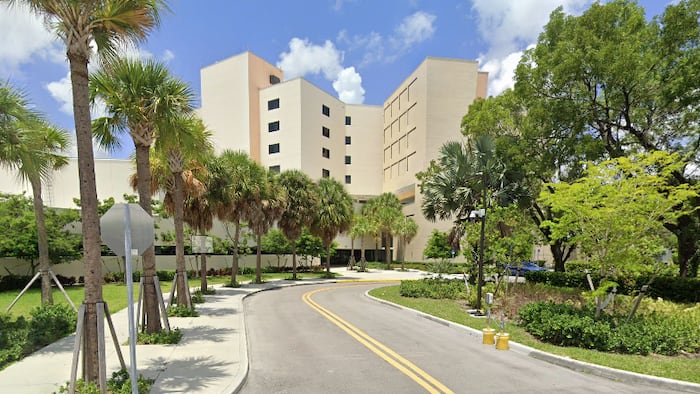
Leifman has even secured funds, which includes opioid settlement dollars, to launch a two-year pilot program at a facility located at 2200 NW Seventh Ave. in Miami’s Allapattah neighborhood.
“The building has every service under one roof so that it is seamless,” said Leifman. “There is a crisis stabilization unit, a short-term residential facility, there is housing, there is psychological treatment, primary, dental, there is a courtroom in there so we can have a hearing right there so we don’t break the chain and people get they need the services they need.”
What remains to open the new mental health center is approval from county commissioners.
But during a Miami-Dade County Intergovernmental and Economic Impact meeting Wednesday, an agenda item sponsored by District 7 County Commissioner Raquel Regalado didn’t make it out of committee.
“It is very sad that it has been deferred without a time certain,” said Regalado. “We have people who are bipolar and schizophrenic and they need to be put into a facility like this in order to receive the care. Some ‘want’ to live on the street because of their mental health. We have a need, I think the board understands the need, I just don’t think they understand the Center and the work that has been done, this is important to the community.”
Some of the commissioners are concerned about what the long-term costs will be to run the facility with programming partners once the one-time installment of funds is exhausted. Others wanted to learn more about eligibility requirements.
Commissioners decided to defer the item without a time certain date of return. The committee’s chairwoman, District 5 Commissioner Vicki Lopez, is calling for a workshop to gather a variety of community stakeholders together before the item comes back.
“And every day that goes by, we are not providing the service, and that is really the sad part,” said Regalado. “So I ask that everyone reach out to the commissioners. This should go before the full board of county commission. This has no reason to be continue to be stuck in committee, it needs to go to the full board so the full board can have this conversation and vote it up or down once and for all.”
Added Leifman: “We are not asking them to allocate one penny at this point. I don’t know what the politics are that got involved with this, it is a little frustrating candidly, but I do believe if we do a workshop and we can show the all the dollars, how we got to all of the numbers, they should be quite comfortable getting this project opened.”
BY THE NUMBERS
The Homeless Trust tells Local 10 News that 25% of its population self-reports having a mental health illness, and 10% report having substance use.
Leifman says about two-thirds of Miami-Dade’s jail population suffers from mental health problems.
“Why do you want to keep doing the same thing,” said Leifman. “It doesn’t make sense to me. This building pays for itself, and you know what, if it doesn’t, you can repurpose the building in 2-3 years.”
The budget breakdown for the center at can be found on Appendix A of the linked document.
MAYOR’S MARCH 3 MEMO
Miami-Dade County Mayor Daniella Levine Cava told commissioners in a memo dated March 3 that the “mission of the center is to divert individuals with severe mental illnesses from the criminal justice system into appropriate mental health treatment, offering both essential clinical care and wraparound services.”
She said the priority population will be individuals “who meet criteria for jail diversion as well as those individuals in need of treatment for co-occurring substance use disorders, such as opioid use disorders. The center will also accept individuals experiencing homelessness and other clients from the community.”
When it comes to operations plan, the mayor said “contracted providers will leverage their existing resources in an in-kind manner to support the Center at no cost to the County.”
Back in 2024, county commissioners approved a resolution to negotiate agreements with Village South for the provision of the core behavioral health services and its parent company, WestCare Foundation, Inc.
Ten years before that, in 2004, the mayor writes that “voters in Miami-Dade County approved the issuance of $22,100,000.00 in general obligation bonds as part of the Building Better Communities General Obligation Bond (“Bond”) Program to fund Bond Program Project No. 193 “Mental Health Facility” located at 2200 NW 7th Avenue, Miami, Florida in order to fund capital improvements to free up jail space and provide an effective and cost-efficient alternative facility to house the individuals who have mental illnesses as they await a trial date.“
The operating agreements she said provides for a 75-bed capacity initial phase:
• 10 beds for crisis stabilization/detoxification services
• 20 beds for short-term rehabilitation treatment services
• 45 beds for residential level-2 treatment services
“Based on the five-year Master Budget depicting contractual commitments and approximate operational costs,” wrote Levine-Cava. “There remains a program shortfall of approximately $6.1 million in the last two years of the five-year forecast. Accordingly, prior Board approval shall be required to exercise the options to renew the contracts with both WestCare and Advocate Program. This will ensure that funding sources to support those expenses can first be identified and approved by the Board.”
Said Leifman: “In some ways they should be chasing us to get it open, not the other way around, because the greatest beneficiary of this project is the county of Miami-Dade County and they don’t quite see it yet, but I just spoke to the Chairwoman afterwards and she really wants to make that happen and I think they just want to have a workshop and then we can move forward.”
🏠 News From Your Neighborhood
Copyright 2026 by WPLG Local10.com – All rights reserved.


