
4 Takeaways From Indiana’s CFP National Championship Game Win Over Miami
HARD ROCK STADIUM (MIAMI GARDENS, Fla.) — The cigar smoke seemed to thicken with each passing second. You could smell it from the hallway outside a raucous Indiana locker room shortly before midnight on Monday night, an hour or so removed from the game-clinching interception by defensive back Jamari Sharpe. And once the doors opened to allow reporters into the fray, where music blasted and screams were unleashed and this unforgettable band of Hoosiers celebrated something so improbable that it’s quite difficult to describe, clouds of hazy hallelujah smacked each newcomer in the face.
A dance battle erupted near the middle of the room. Roughly two dozen players — all of them seemingly cloaked in black national championship T-shirts and matching hats — bouncing and bopping and blaring the lyrics to rap anthems loud enough to rattle the walls. Toward the back, two players shared a toast with nips of Fireball Cinnamon Whiskey and downed their shots as a cell phone camera recorded. “You didn’t see that,” one of them said to a passing reporter. Toward the front, two staffers wondered aloud where they could find some beer.
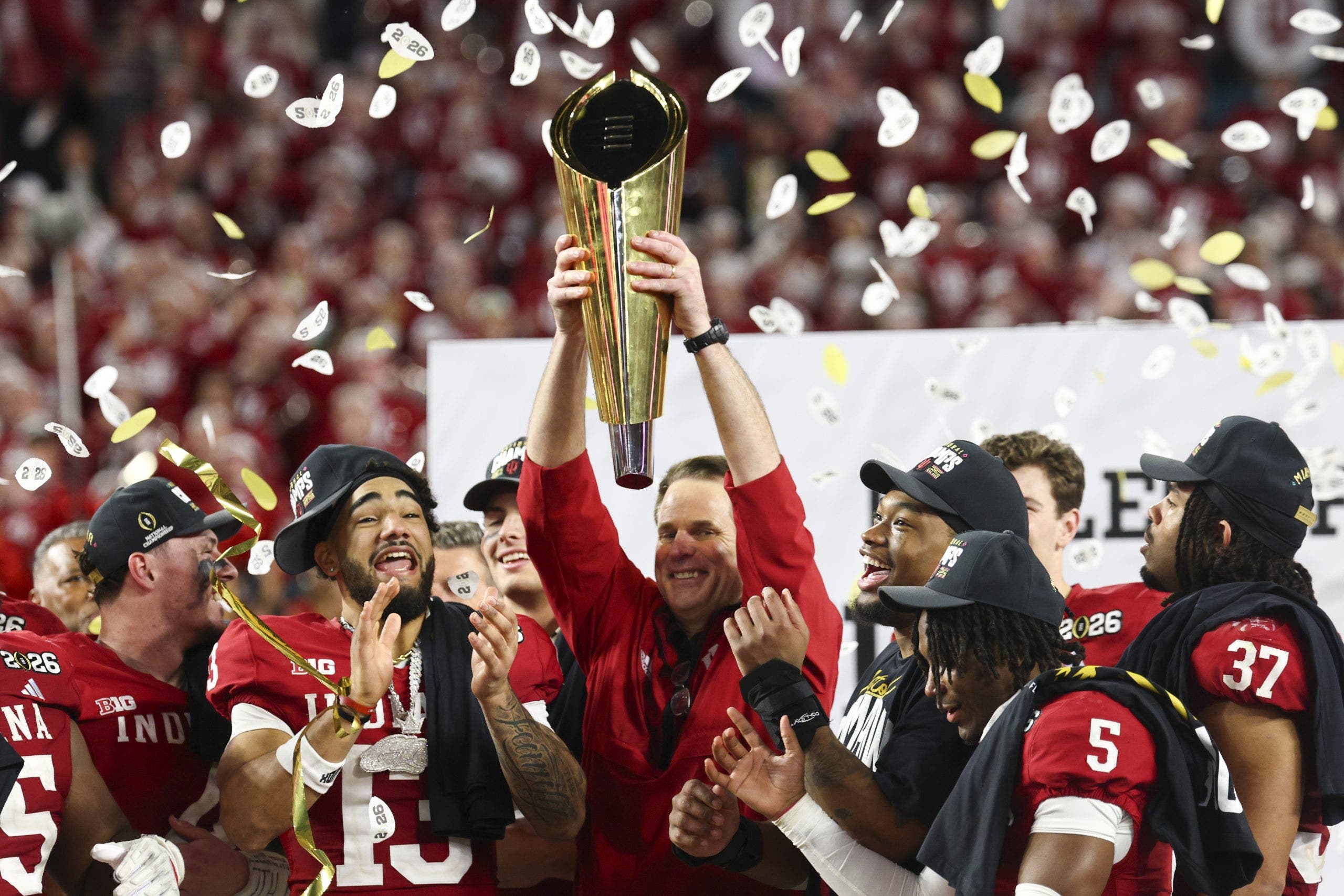
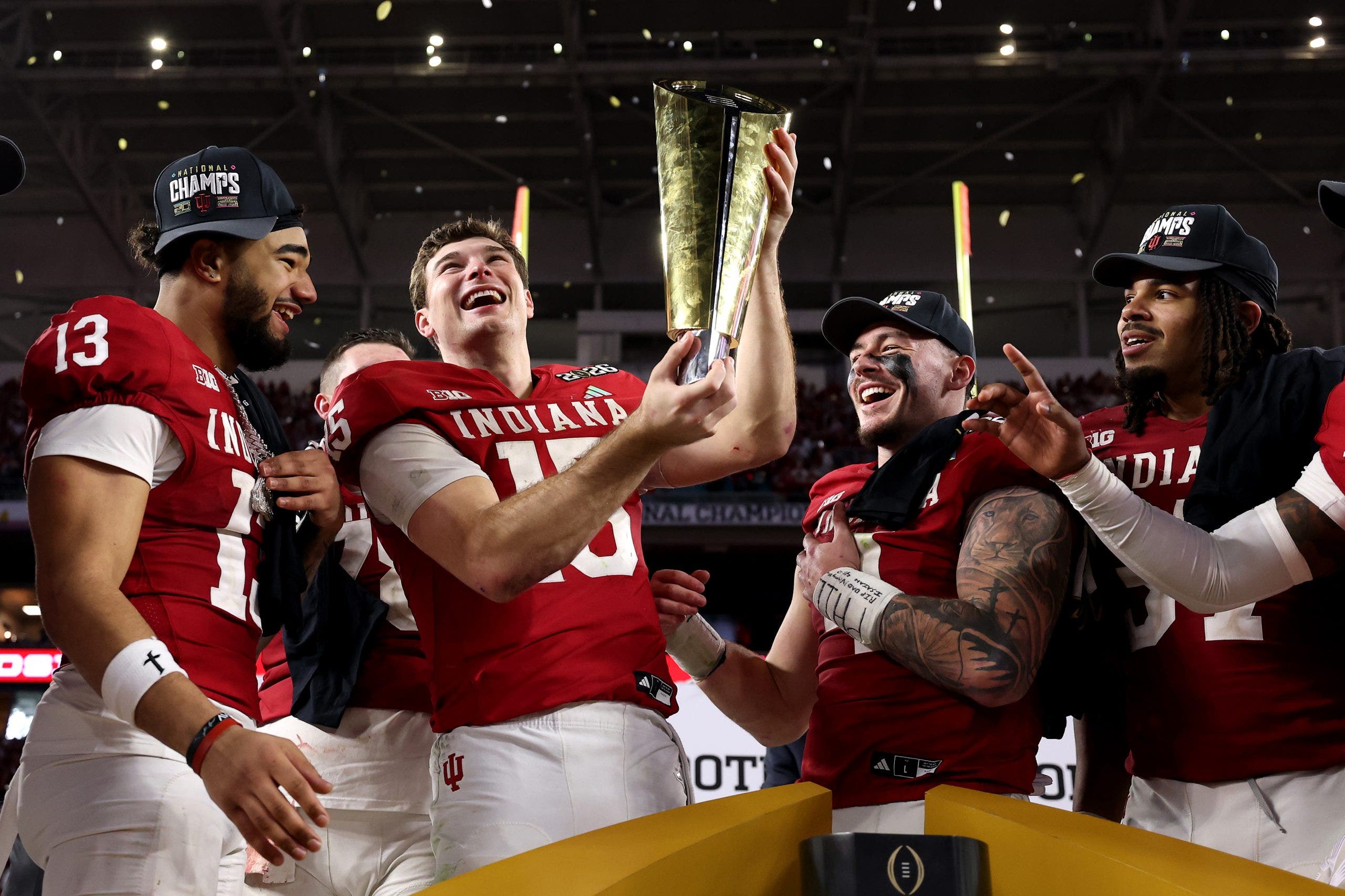
This is what it looks like when a program that began the season with more losses than any in college football history authors perhaps the greatest story American sports has ever seen. This is what it looks like when traditional Big Ten bottom feeder Indiana becomes the first team to finish a season 16-0 since Yale in 1894, punctuating the task with the first national championship in school history. This is what it looks like when a 64-year-old head coach named Curt Cignetti, who paid his dues at IUP, Elon and James Madison, flashes a complete mastery of the modern era by building a roster full of underrecruited and overlooked players who wanted nothing more than to embody their leader’s unwavering intensity and impose his will — their will — on every opponent Indiana encountered.
The latest victim, the final victim, was No. 10 Miami in the Hurricanes’ own stadium, where proud Indiana supporters formed the majority of a crowd numbering 67,227 fans, every one of whom was metaphorically drunk on an elixir typically reserved for programs like Ohio State, Alabama, Georgia and Michigan. But Cignetti and his unshakable team of unbreakable players did what they’ve done all year to upend Miami, 27-21, and finish this fairytale so perfectly that even Hollywood might balk at the script.
“I think we sent a message, first of all, to society that if you keep your nose to the grindstone and work hard and you’ve got the right people, anything’s possible,” Cignetti said in the postgame news conference. “In our particular situation in the athletic world, college football has changed quite a bit. The balance of power, also. But we have the right people on our staff, in the weight room, in the locker room, and we have great senior leadership and togetherness, and we had a really good quarterback that played his best when the chips were down.”
Here are my takeaways:
1. Curt Cignetti cemented his legacy
(Photo by Jamie Schwaberow/Getty Images)
His stones were laid bare for everyone to see. It was fourth-and-4 from the Miami 12-yard line with 9:27 remaining in the fourth quarter when Cignetti — scowling, frowning, hands-on-hips, pacing anxiously along the sideline — called timeout to ponder the season-defining decision he was about to make. Would he really pull his kicking unit off the field and renege on an opportunity to extend the Hoosiers’ lead to 20-14? Would he really send his offense back out there for such an unnecessary risk?
That Cignetti answered both of those questions in the affirmative left both sides of the crowd at Hard Rock Stadium stunned. Anticipation bubbled and surged as the play clock wound down. Guts tightened. Fists clenched. One play to turn the tide in a national championship game that, for the better part of three quarters, felt thoroughly controlled by the top-ranked Hoosiers before it slowly began slipping away. One play for Cignetti to become immortal. But only if it worked.
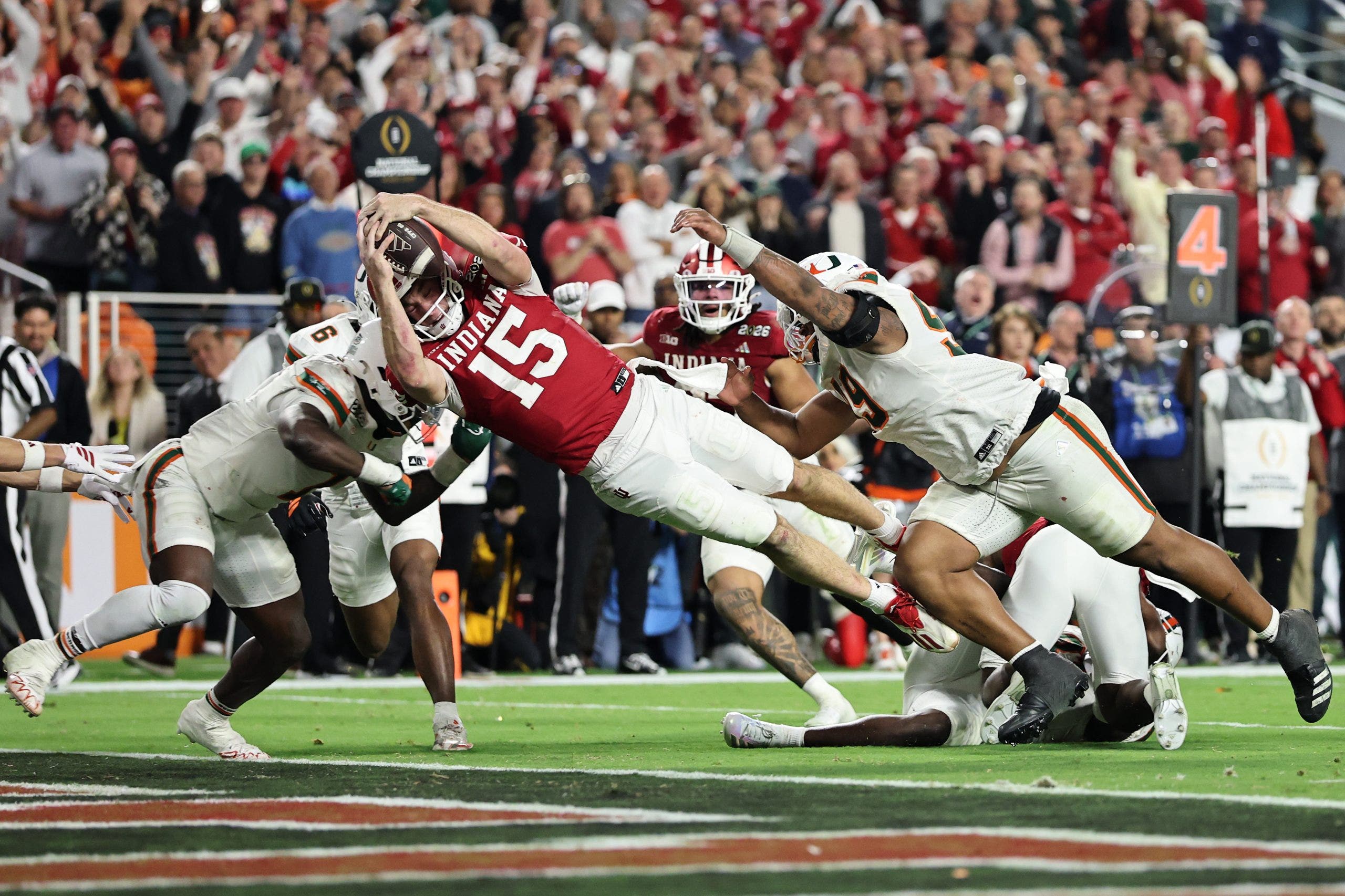
The decision from Indiana offensive coordinator Mike Shanahan kept the ball in his Heisman Trophy winner’s hands with a designed quarterback draw: up the middle and between the gaps of an offensive line that had cracked enough in the opening half to where Mendoza absorbed a beating. But this time, when the Hoosiers absolutely had to have it, Mendoza surged across the line of scrimmage with purpose, planted his left foot in the ground to change direction and plowed through two defenders at the 5-yard line. Then he placed his right hand on the turf for balance and dove backward into the end zone for a touchdown that will be replayed in Bloomington for generations.
“I’ll just remember it as Fernando is just an absolute beast,” Indiana wide receiver Charlie Becker said in the locker room. “I thought he was going to be tackled 10 yards ago and this dude is just spinning and diving. It’s just a testament to his character. Fernando, he’ll do anything for all of us and our teammates. He’ll go out there and put his body on the line for us.”
(Photo by Carmen Mandato/Getty Images)
For as superhuman as Mendoza’s run truly was, the play itself said as much or more about Cignetti than anyone else. It was Cignetti’s unflappable, unparalleled self-belief that underwrote his eyebrow-raising decision to accept the Indiana job to begin with, willingly tossing himself into what many considered the worst job in the Big Ten. It was his unmatched eye for talent that constructed a team full of self-proclaimed “misfits” and transformed those players into giant killers and blue-chip slayers. It was his incredible aptitude for quarterback development that elevated a former zero-star recruit in Mendoza into the Heisman Trophy recipient and likely No. 1 overall pick in the NFL Draft.
The numbers surrounding Cignetti’s first two years at Indiana are staggering: With an overall record of 27-2, he has the most wins by any Big Ten head coach to begin a tenure; he’s the first coach to win a national title within two seasons of taking over a program since Gene Chizik did so in Year 2 at Auburn during the 2010 campaign; he’s joined Larry Coker, Dennis Erickson and Barry Switzer as the only coaches to win a national title and post multiple 10-win seasons in his first two years at a given school. It’s no longer a stretch to consider him the best college football coach in the country.
“What does it not say about Coach Cig?” Indiana linebacker Aiden Fisher said in the locker room after the game. “That guy is unbelievable. I would love to tell you two years ago [that] I thought this was going to happen. I’d be lying. Coach Cig 100 percent believed it, and this is just unbelievable. I don’t think it’s hit me yet.”
2. Back-shoulder throws are Indiana’s bread and butter
(Photo by Alex Slitz/Getty Images)
Part of what makes Indiana’s offense so impressive is that almost nothing the Hoosiers do is gimmicky. They don’t motion for the sake of motion; they don’t use running backs or tight ends as auxiliary quarterbacks in wildcat alignments; they don’t employ trick plays. The system devised and perfected by Cignetti and Shanahan is rooted in pro-level concepts made effective by ruthless precision. And so, even though most defensive coordinators know exactly what the Hoosiers are going to do, not a single opponent on Indiana’s schedule this season could stop it.
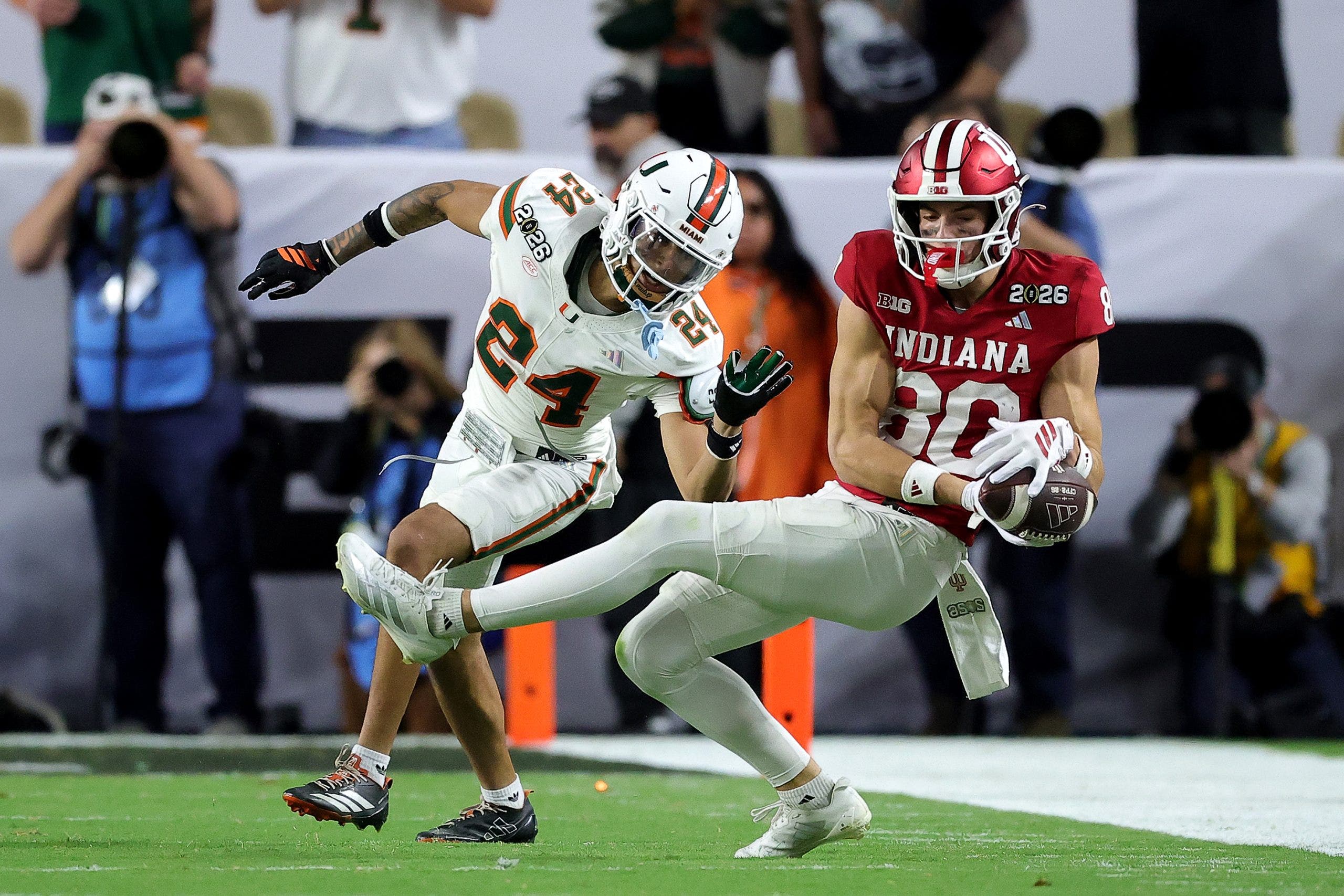
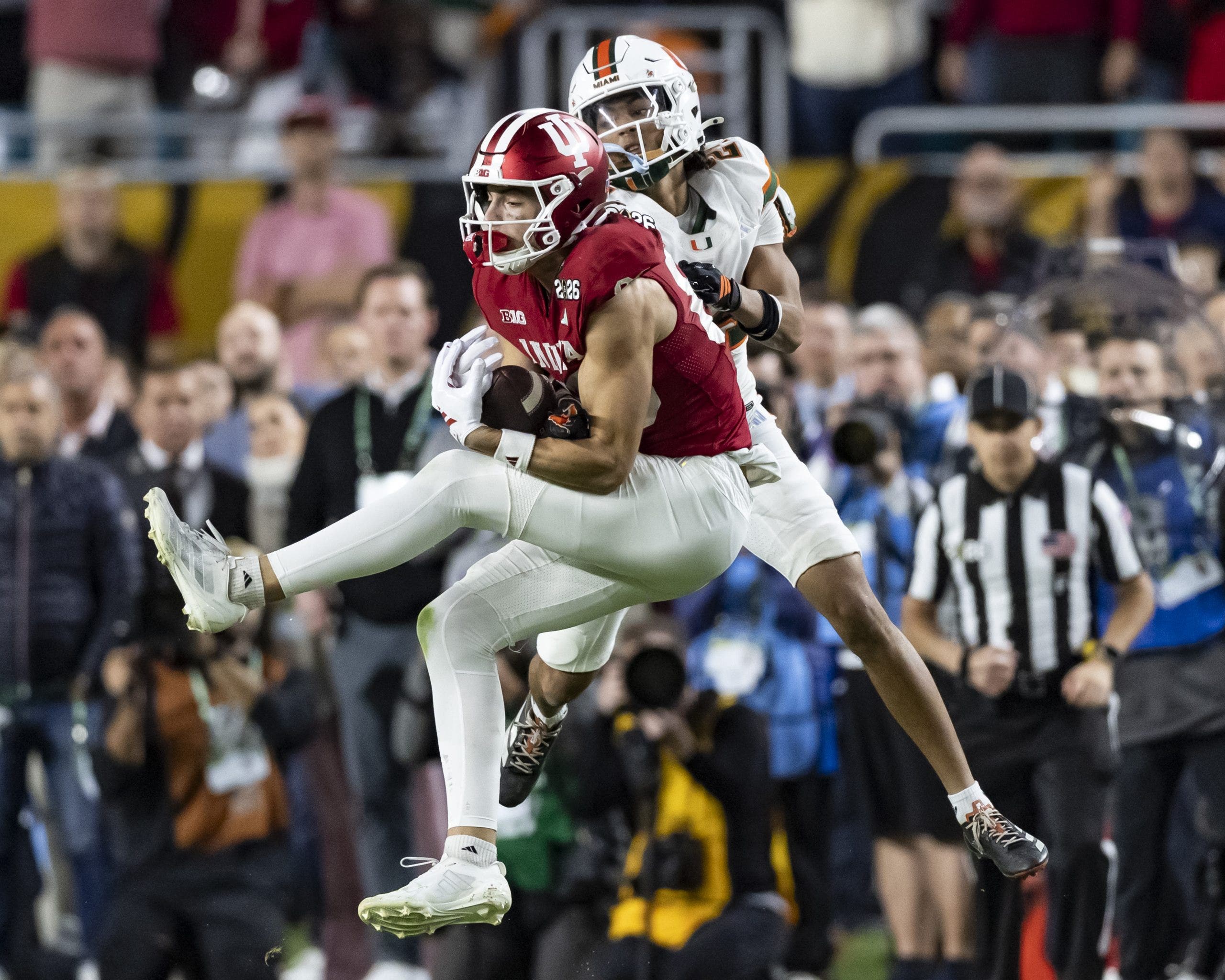
Case in point: the back-shoulder throw. No quarterback in college football throws it better than Mendoza. No receivers in college football haul them in as regularly as Indiana’s trio of Elijah Sarratt, Omar Cooper Jr. and Charlie Becker. “Too many to count,” Becker told me when asked how many such passes he’s caught from Mendoza in the last calendar year.
On Monday night, when Indiana’s bid for a national championship began to teeter, Mendoza connected with Becker — his roommate — for two acrobatic completions that left Miami defensive back Ethan O’Connor facing the wrong direction both times. The first was a 19-yarder on fourth-and-5 amid the Hoosiers’ opening possession of the fourth quarter, with a leaping Becker landing delicately along the sideline to preserve a drive that ended with a touchdown. The second came in the waning moments, on third-and-7 near midfield, with Mendoza rifling another 19-yard completion that moved the chains and forced the Hurricanes to begin taking timeouts.
(Photo by Steve Limentani/ISI Photos via Getty Images)
“Me and Fernando,” Becker said in the locker room, “as soon as he got here in the spring, we got to work. We worked on like every single route at like 5:30 in the morning. It’s all that hard work. Not just me, all these guys. We all put in that extra work after workouts were done. What this is, it’s just a combination of all that extra work we’ve put in.”
Two days prior, on Saturday morning, Miami defensive coordinator Corey Hetherman was asked how the Hurricanes would defend the kinds of passes often described as indefensible. He gave a detailed and eloquent answer about the importance of winning the first five yards once the ball is snapped, about remaining in-phase with receivers down the sideline. He said the particular techniques Miami’s defensive backs are told to employ can change on a weekly basis, be that chest to chest or playing through the inside arm. In the end, Hetherman said, it would come down to trusting fundamentals and technique.
“Our guys have done a good job of not panicking in that situation,” Hetherman told me over the weekend, “not panicking in the moment and trusting the process and trusting the way that they were coached and the way that they did it in practice and really in the drills every single day.”
But when the moment finally arrived and O’Connor had not one, but two chances to showcase everything the Hurricanes had practiced so diligently all season, Mendoza and Becker showed the world that Indiana simply does it better.
3. Hit early and often, Fernando Mendoza never blinked
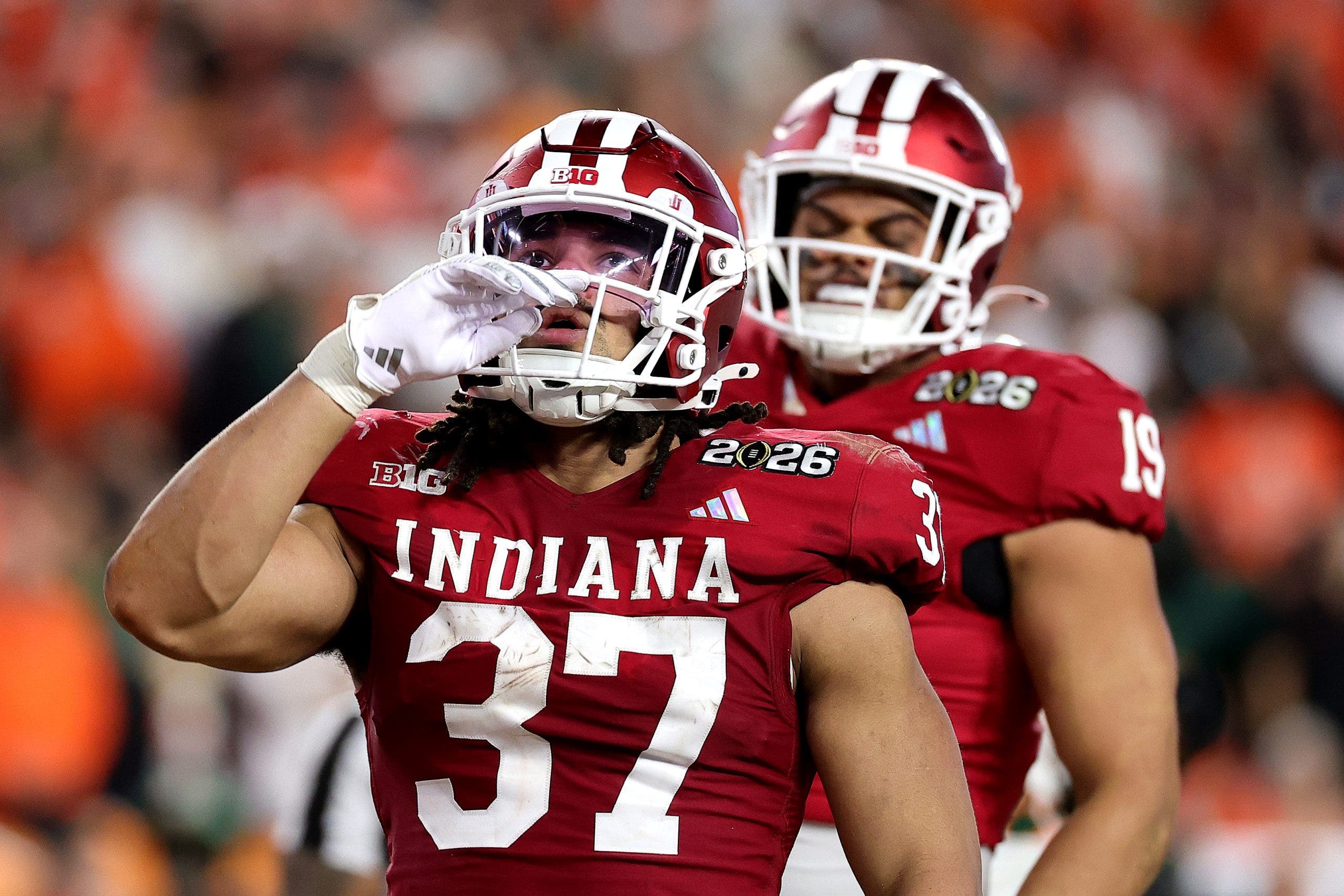
Barely 12 minutes had elapsed before a flurry of hits from the Hurricanes’ heat-seeking defense bloodied the mouth and face of Mendoza, whose case was argued to the referees by an impassioned Cignetti via hand gestures and harsh words alike. Time and again in the opening quarter, Miami de-cleated Mendoza on both passes and run fakes, roaring into the backfield while executing the timely pressures dreamed up by Hetherman, who used to work for Cignetti at James Madison. The passing numbers were still respectable — Mendoza completed seven of his first 10 attempts for 70 yards in the opening quarter and wasn’t sacked — but the physical toll seemed compounding and real.
With Indiana leading 3–0 at the end of the first quarter, it was fair to wonder what might have been floating through Hetherman’s mind, given how he had described Mendoza at the Hurricanes’ media session two days earlier. Seated behind a podium inside the Miami Beach Convention Center, he suggested that Mendoza actually improves the more often he gets hit. Clutch performances in narrow victories over Iowa, Indiana, Oregon and Ohio State, all of whom literally rattled Mendoza at times, seemed to lend credence to Hetherman’s theory.
Beginning with Indiana’s opening drive of the second quarter, which followed a third consecutive three-and-out by a stagnating Miami offense, Mendoza completed four of his next five passes while overseeing a marathon 14-play, 85-yard drive that ended with a short touchdown run. He produced gains of 12 yards, 8 yards and 15 yards in addition to a devilishly placed back-shoulder throw that elicited a critical pass interference penalty against cornerback O.J. Frederique Jr. on third-and-6.
(Photo by Alex Slitz/Getty Images)
When Indiana tight end Riley Nowakowski powered across the goal line on an inside handoff, smashing Miami’s defensive line at the point of attack, the Hoosiers’ lead swelled to 10-0. They drained nearly seven minutes off the clock and gained more yards on that one possession than Miami did in the entire first half. Mendoza entered the locker room having completed 12 of 17 passes for 116 yards.
“Let me tell you, Fernando, I know he’s great in interviews and comes off as the All-American guy, but he has the heart of a lion when it comes to competition,” Cignetti said in the postgame news conference. “That guy competes like a warrior. He got really smacked a few times in this game. That one drive [where] we kicked a field goal, there should have been two roughing the quarterbacks and one high hit to the head that weren’t called. I’m all for letting them play, but when they cross the line you’ve got to call them.”
4. The Big Ten is now college football’s premier conference
(Photo by Patrick Smith/Getty Images)
Prior to kickoff on Monday night, during the portion of pregame when luminaries and celebrities were gladhanding their way around the field, posing for photos and ensuring they’re seen, several conference commissioners were among the dignitaries meandering to and fro.
First, there was SEC commissioner Greg Sankey, whose league failed to produce an entrant in the national championship game for a third consecutive season. It’s the conference’s longest such drought since a four-year chasm from 1999-2002, when the BCS system was still deciding college football’s fate. Next, there was Big 12 commissioner Brett Yormark, whose league winner and only College Football Playoff participant — Texas Tech — was shutout by Oregon in the quarterfinals. The Big 12 hasn’t won a national title since former league member Texas knocked off USC during arguably the greatest championship game of all time in 2005.
[ALL-TIME TURNAROUNDS: Where do Indiana, Patriots, Cubs Rank?]
Neither Sankey nor Yormark could have truly enjoyed what they were about to watch at Hard Rock Stadium, where a third different Big Ten team captured the league’s third consecutive national title. A run that began with Michigan’s undefeated season in 2023 and continued with Ohio State’s postseason dominance in 2024 was extended for at least another year with Indiana’s 27-21 victory over Miami. It marks the first time that the Big Ten has won three straight championships since the early 1940s, when Minnesota won two in a row and Ohio State punctuated the trio. Indiana also became the sport’s newest first-time national champion since Florida in 1996.
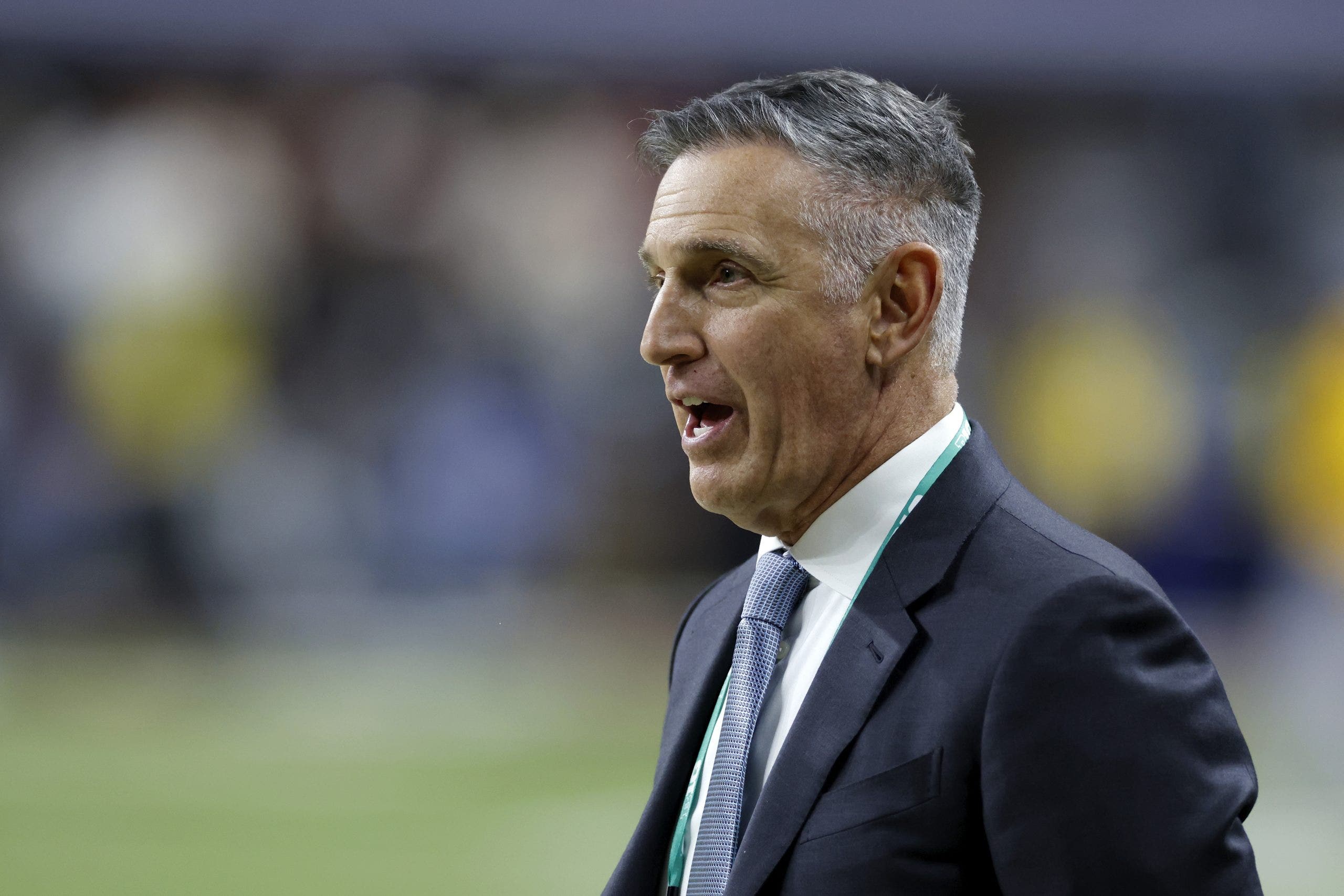
“This has been the best experience,” Big Ten commissioner Tony Petitti said in a postgame interview. “The coaches, all the players — and obviously it means so much for Indiana. But it means a lot to the entire league, all of our coaches, all of our players. What Indiana has done in two years, I’ve never seen anything like it in all the years I’ve worked in sports. So I’m just blown away.”
(Photo by Joe Robbins/Icon Sportswire via Getty Images)
The outcome left Petitti as both the happiest leader in collegiate athletics and arguably its most powerful — an unofficial position long reserved for Sankey. It’s Petitti who can now revel in capturing the sport’s biggest prize to punctuate an uneasy stretch in which he shouldered heavy scrutiny for the league’s proposed private capital deal and backing of a 24-team playoff format during the ongoing structural debates.
And yet there Petitti was during the on-field celebration Monday night, sharing a laugh with Indiana athletic director Scott Dolson atop the stage as the joyful ceremony unfolded all around him. Petitti certainly has detractors — plenty of them — but he’s also got the last three national champions in his league.
“I feel like we’re just getting started,” Petitti said. “We’re feeling really good about where we are in football. Week in and week out, the quality, the strength of our players, the level of coaching that we have, the commitment on behalf of all 18 members to excel and play hard, the fans that we have, the stadiums — we feel really good about where we are. I think we’re headed for really great things. These last three years have been incredible. I just expect even more.”
4½. What’s next?
Indiana will enter its offseason having already completed most of its critical business. In mid-October, Dolson successfully inked Cignetti to a new, eight-year contract worth $93 million that runs through 2033, though the school is now obligated to increase the annual pay so that Cignetti remains among the three highest-paid coaches in the country, having recently been passed by new LSU head coach Lane Kiffin. The Hoosiers also locked in defensive coordinator Bryant Haines and offensive coordinator Mike Shanahan to lucrative new deals worth more than $5 million per year combined, entrenching them among the sport’s richest coordinators.
[2026 CFP TITLE ODDS: Indiana, Ohio State Open as Favorites]
Such impressive retention certainly played a factor in Indiana’s transfer portal success earlier this month, with the Hoosiers quickly securing 17 players for a class that now ranks seventh nationally and third in the Big Ten behind Ohio State and Penn State. The leading additions were former TCU quarterback Josh Hoover, former Michigan State wide receiver Nick Marsh, former Penn State cornerback A.J. Harris, former Wisconsin interior offensive lineman Joe Brunner and former Kansas State edge rusher Tobi Osunsanmi — all of whom rank among the top 125 prospects in the portal, according to 247Sports. The Hoosiers’ high school recruiting class sits 34th nationally and ninth in the Big Ten.
There is more work to be done at Miami, which secured a top-12 transfer portal class each of the last four cycles but has endured a significantly slower start to player acquisition in 2026. Despite this season’s trip to the national championship game, the Hurricanes only earned six commitments prior to kickoff on Monday night, two of whom are kickers. Three newcomers rank among the top 135 portal entrants in former South Carolina wide receiver Vandrevius Jacobs, former Boston College safety Omar Thornton and former West Virginia wide receiver Cam Vaughn.
The biggest unknown is at quarterback now that Beck’s long and winding collegiate career has ended. A shocking last-minute portal entrance from Duke quarterback Darian Mensah triggered immediate speculation about his potential move to Miami, which hit on transfer quarterbacks each of the last two seasons in Beck and former No. 1 overall pick Cam Ward. There are potential hurdles to navigate surrounding Mensah’s existing NIL deal with the Blue Devils, who signed him to a two-year agreement prior to the 2025 campaign. But rumblings from in and around the Hurricanes the last few days suggest there’s a legitimate chance Mensah will be the program’s quarterback of the future.
Michael Cohen covers college football and college basketball for FOX Sports. Follow him at @Michael_Cohen13.
Want great stories delivered right to your inbox? Create or log in to your FOX Sports account, and follow leagues, teams and players to receive a personalized newsletter daily!

:no_upscale()/cdn.vox-cdn.com/uploads/chorus_image/image/72607538/1245818717.0.jpg "Miami Dolphins fullback Alec Ingold contract extension 2023: How contract came together, how Miami uses fullback")