Messi, Inter Miami’s MLS Cup title ends one era, ushers in a more ambitious future
FORT LAUDERDALE, Fla. — It was 6:38 p.m., nearly two hours after the final whistle sounded on Inter Miami’s first MLS Cup, but Lionel Messi still hadn’t taken his pink cleats off as he stood next to the open door of his black Cadillac Escalade giving an interview.
The legendary Argentine wore a gray Inter Miami MLS Cup Champions shirt darkened by whatever booze was sprayed in the home team’s locker room. As he finished speaking, he finally slipped the boots off those magical feet that helped set up all three goals in Inter Miami’s 3-1 win over the Vancouver Whitecaps.
Then he got into the car, fired up the engine and drove out of the stadium — off and away from the first chapter of his Inter Miami story.
Chase Stadium is an unspectacular temporary venue constructed as a stopgap while Inter Miami searched for its permanent home in South Florida. It represents just how early into its history this club is. Saturday marked the end of only the sixth season in existence. Messi’s arrival in 2023 took a brand-new organization still searching for a way to successfully marry its ambition to reality and turned it into a global brand.
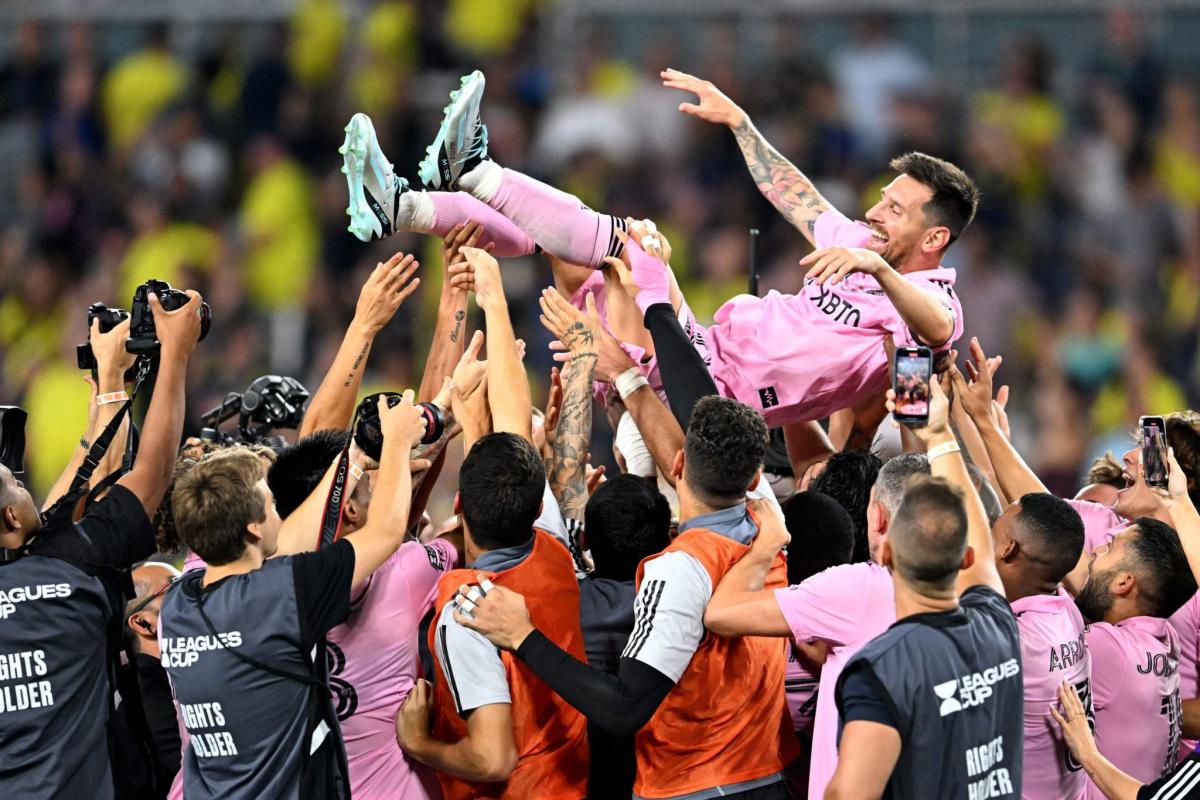
It felt fitting that the final season here — and the last game of this first chapter of Messi in Miami — ended with a trophy. It also felt appropriate that it was delivered by Messi’s brilliance. The first goal opened with him slipping between two defenders with a couple of deft touches, then lifting a little pass to Tadeo Allende to put him into space en route to the goal. Messi then engineered the next two goals, including a brilliant assist where he took the ball off his chest and put the pass through to Allende again out of the air on the next touch.
“Three years ago, I decided to come to MLS, and today we are MLS champions,” Messi said. “This is the moment I had been waiting for, and that we, as a team, were waiting for. It’s very beautiful for all of us.”
DALE CAMPEOOOOON DALE CAMPEOOOOON 🍾💗 pic.twitter.com/uqvCRuGLRJ
— Inter Miami CF (@InterMiamiCF) December 7, 2025
But even with the confetti still glittering on the field, thoughts were already pivoting to what comes next. As the team celebrated in front of its fans, Inter Miami owner Jorge Mas couldn’t wipe the smile from his face.
“This is amazing, I have an overwhelming feeling of gratitude,” he told The Athletic. “It’s the culmination of everything we’ve worked for. It’s been super hard to get here. But finally we’re showing the world what’s possible. And next year, 2026, we’ve got to win the (Concacaf Champions Cup) and get to the Club World Cup.
“It ain’t over.”
Messi in Miami 1.0 will be forever remembered for its star power — and an imperfect road to the club’s first championship.
The first thrilling month of Messi in MLS in 2023 culminated with a penalty-kick win over Nashville in the Leagues Cup final. Everything had gone nearly perfectly as Miami slalomed through its first competition with a star coming off of a legacy-defining World Cup win. When he lifted the Leagues Cup trophy, it felt like Miami would be unstoppable going forward.
But Messi missed much of the end of the regular season with an injury, and a Miami team that had been in last place in the league when he arrived couldn’t dig fully out of the hole it was already in and missed the playoffs. The next season, Miami was dispatched from the Concacaf Champions Cup in the quarterfinals by Liga MX’s Monterrey and then, after setting the MLS points record and winning the Supporters’ Shield, was stunned by Atlanta United and sent packing in the first round of the playoffs.
Tata Martino resigned as coach due to personal reasons after that defeat, and Inter Miami suddenly felt unmoored. Going into 2025, even with the two trophies in two years, it felt like a crucial point for Miami to prove that Messi was about more than just commercial impact.
The biggest and most important trophies — Concacaf Champions Cup and MLS Cup — had eluded them. They needed one to validate the sporting side of the project.
After Vancouver knocked Miami out of the Concacaf Champions Cup in the spring, those questions only got louder. But Inter’s new coach, Messi’s former Argentina and Barcelona teammate Javier Mascherano, insisted that even in loss, the team was learning.
“You have to remember, Inter Miami hasn’t had many opportunities to play games like these,” he said in May. “We’re still learning. The results will come in the future. Rome wasn’t built in a day. Greatness comes from big nights, from victories, comebacks, and even from mistakes. We’ll keep pushing, because we believe this team can compete.”
Messi’s free-kick goal vs. Porto delivered Miami and MLS a signature moment at the FIFA Club World Cup (Alex Grimm / Getty Images)
In the summer, Miami was the only MLS team to advance out of the group stage of the Club World Cup. Though it fell to PSG in the knockout stage, the performance overall seemed to buoy the team.
“We leave with pride to have achieved the goal of making it to the top 16 of the tournament,” Messi posted on his Instagram.
Coming out of the summer, the No. 10 looked to be on a mission to get a trophy — especially because it started to feel like the end of an era.
The former Barcelona star had been surrounded by a familiar collection of old friends and teammates from the historic Spanish club since arriving in Miami. Jordi Alba and Sergio Busquets made the move along with him that summer. Luis Suárez joined the next season. But at least two of the three won’t be back next year, after Alba and Busquets both announced their retirement.
Messi, meanwhile, scored eight goals in his next five games after the Club World Cup. Then, beginning in August, he went on a tear, scoring 11 goals with 10 assists in the final 10 games of the regular season. His playoff form (six goals and nine assists in six games) was arguably better.
Messi made it clear he wanted to send his good friends out the way he did on Saturday night — with a title.
“Given what they’ve been — as players, both were among the greatest in history, each in his position, with the careers they had and the titles they won — it’s wonderful that they can retire with this MLS title,” Messi said. “I don’t think they’re fully aware yet of what they’re experiencing, of what it means to retire. Today something very beautiful ends for them, something to which they dedicated their whole lives. Now a new life begins for them. I wish them the very best, because they are two friends I care for deeply. I’m happy they can leave with this title.”

Inter Miami owner Jorge Mas stands with retiring stars Sergio Busquets and Jordi Alba, who were presented with commemorative plaques (Maddie Meyer / Getty Images)
Inter Miami has successfully closed the door on the first chapter of its Messi era. But ambition isn’t temporary. So what comes next for a club that proclaims “it ain’t over?”
Suárez, 38, could return as a reserve, sources with direct knowledge of discussions told The Athletic. Messi’s Argentina teammate, Rodrigo De Paul, will occupy a designated player spot next to Messi, one of the two vacated by Busquets and Alba.
But the way Inter Miami exploded through the playoffs could make Inter Miami rethink about what the next version of its build looks like. It felt like the playoffs provided a path for the transition from 1.0 to 2.0. After initially having his hand forced via MLS suspension, Mascherano kept Suárez on the bench as wingers Mateo Silvetti and Allende, who set an MLS record with nine playoff goals, created space around Messi. Surrounded by younger legs on the wings, the maestro was at his very best, scoring or assisting on 15 of Miami’s 20 postseason goals.
Messi, Suárez and De Paul still deliver the star clout. Will Miami look for another big name to fill its third designated player spot? One thing can be certain: the move almost certainly will match the same ambition that brought Messi to the club.
“We say goodbye today to two generational players,” Mas said. “But we’ll reload.”
Miami will enter its next era by opening a billion-dollar stadium. Miami Freedom Park will be a home more befitting of a Messi-led club. Miami will also have a star above its crest when it steps out onto that field next season. It was no coincidence that Messi went to the under-construction stadium to sign a three-year contract extension, and as he put pen to paper he seemed to embrace the next, and likely final, phase of his playing career.
His transition to being an owner of Inter Miami feels as present as ever, and his recent comments indicate his desire to not just push his club forward, but also his league.
In an interview with NBC News, Messi spoke publicly about MLS’ need to grow and change. It put the star player in line with the philosophy of a club that has always pushed back against the league’s more conservative approach to spending.
De Paul’s addition to this team as a non-designated player, and the workaround needed to pull it off, is proof of that. No doubt Miami will use its success in 2025 as further proof of concept that MLS is a league begging for change — and that the right levels of ambition, spending and star power can help MLS break through the noise.
It’s an idea that feels like it’s building on the risk David Beckham took when he first left Real Madrid to join MLS in 2007. No global stars of Beckham’s age had yet made that kind of leap. His willingness to be the first, and the creation of the DP rule that came with it, changed the league forever.
Now, Inter Miami is ushering MLS toward its next iteration, with Messi the catalyst.
“When I first came here almost 20 years ago, I knew that there was going to be a challenge, but in all honesty, I knew the potential (that) America had for this sport,” Beckham told The Athletic. “I always promised the commissioner that my commitment wasn’t just to the Galaxy, it was to improving and making this sport stronger in this country.”
Messi’s arrival was a massive part of fulfilling that commitment. But, as Mas said, there has to be more.
It can’t be over.

David Beckham hugs Lionel Messi after Inter Miami captures its first MLS Cup title (Rebecca Blackwell / AP Photo)
It’s easy to take for granted what we just witnessed. It’s old hat, after all, for Messi to dominate a league and to win trophies.
From the first day Messi arrived in MLS, he made clear to those inside and outside the club that he was here to win. It wasn’t a trip to the beach.
People of course would say he’s just here to retire, even as he continued to win with Argentina. But Saturday’s win validated Messi’s famous competitiveness. It also validated what Miami dreamed of when it started to chase Messi in 2019 with a secret flight to Barcelona to meet with his father.
Saturday’s MLS Cup wasn’t just the culmination of all the work Inter Miami’s owners had done, as Mas said, nor was it even just a sign of a league’s growth and progress over the last quarter-century.
Really, the win represented the opportunity that Messi creates for the league.
There’s limited time left to watch a player who can still thrill the way he did on Saturday afternoon. Just as Beckham’s arrival forced the league to change for the better nearly two decades ago, Messi’s decision to close out his unmatched career in MLS comes at a time when the league is ready for its next steps.
Messi lifting MLS Cup is an image that will now be seen around the world. It’s an unprecedented advertisement for North American soccer. That opens the door for MLS to seize the moment. If Messi in Miami 1.0 was about proving an unrivaled star can help MLS break through globally, Messi in Miami 2.0 is about taking that promise to new heights.
It ain’t over.