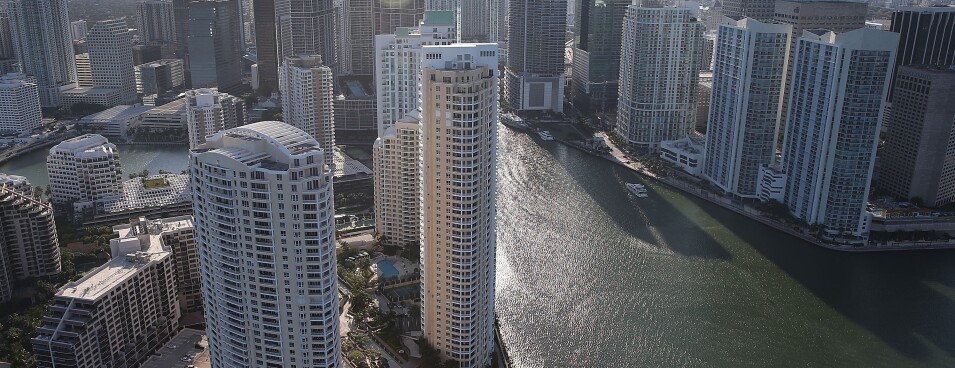
Miami Faces Greatest Real Estate Bubble Risk, Followed By Tokyo, Zurich – UBS
Where is the most severe property market “bubble trouble.” UBS, seeking to answer that question, has released its “Global Real Estate Bubble Index 2025” report. It shows which cities face low downside risk, where corrections are likely, and where price increases are set to pick up again.
According to this year’s edition of the UBS Global Real Estate Bubble
Index, Miami faces the highest bubble risk among the cities
in this study, followed by Tokyo and Zurich. Over the
last four quarters, global home prices remained virtually
unchanged in inflation-adjusted terms, as housing
affordability weighed on demand.
.jpg)
UBS analysed residential property prices in 21 major cities
around the world for the study which finds that an elevated
risk is also evident in Los Angeles, Geneva, Amsterdam, and
Dubai. The latter recorded the strongest risk increase from the
prior edition together with Madrid, the firm said in a
statement.
The UBS Global Real Estate Bubble Index traces the valuation of
owner-occupied housing markets and the valuation of cities in
relation to their country and economic distortions, such as
lending and building booms.
Risks are moderate in Sydney, Vancouver, and Toronto. Madrid,
Frankfurt and Munich also fall into the moderate-risk group.
According to the index, London, Paris and Milan face low bubble
risk. Outside Europe, Hong Kong, San Francisco, New York and
São Paulo are in the same category, with São Paulo showing
the lowest risk among all cities analysed, the survey
shows.
Global housing markets continued to cool on average. “Broad
exuberance has faded, with average bubble risk in major
cities falling for a third straight year,” Matthias Holzhey, lead
author of the study at UBS Global Wealth Management’s chief
investment office, said. “Cities flagged with high bubble risk
in 2021, like Frankfurt, Paris, Toronto, Hong Kong or
Vancouver, saw average real price drawdowns of nearly 20 per
cent from their peaks as interest rates rose in subsequent years.
By comparison, inflation-adjusted prices in cities with
lower imbalances fell about 5 per cent on average.”
But some cities have bucked the trend. Over the past five years,
Dubai and Miami were the front runners with average real
price growth of roughly 50 per cent. Tokyo and Zurich followed,
with growth of 35 per cent and nearly 25 per cent. Compared
with last year, Madrid recorded the strongest real price
growth among all cities analysed, with a 14 per cent
increase.
Affordability squeeze raises regulation
risk
Hong Kong is the least affordable city in the study, property
buyers require about 14 years of income to purchase a 60
sqm apartment (650 sqft). Prices have also decoupled from
local incomes in Tokyo, Paris and London. Price-to-income ratios
there exceed the factor 10. Overall, for a skilled service
worker, a financially affordable living space is, on
average, about 30 per cent smaller than in 2021.
If property becomes too pricy for citizens, additional
regulations are often introduced. “Tougher rules, from new taxes
to outright purchase bans to rent control measures, have
dimmed the appeal of once sought-after markets such as
Vancouver, Sydney, Amsterdam, Paris, New York, Singapore and
London,” Maciej Skoczek, author of the study at UBS
Global Wealth Management, said.
The UBS Global Real Estate Bubble Index traces the valuation of
owner-occupied housing markets and the valuation of cities in
relation to their country and economic distortions, such as
lending and building booms. Based on the valuation, the
“bubble risk” is assessed: low (score below 0.5), moderate (0.5
to 1.0), elevated (1.0 to 1.5), and high (above 1.5). This
classification is aligned with historical bubble episodes.
However, the method cannot predict if or when a correction will
happen, hence “bubble risk” refers to the prevalence of a
risk of a large price correction.
The index score is a weighted average of the following five city
sub-indices, standardised using expanding window procedure:
price-to-income and price-to-rent ratios (fundamental
valuation), change in mortgage-to-GDP ratio and change in
construction-to-GDP ratio (economic distortion), and
city-to-country price ratio. The city-to-country price ratio in
Singapore, Hong Kong, and Dubai is replaced by an
inflation-adjusted price index.
Regional highlights
Miami
Over the past 15 years, Miami has posted the strongest
inflation-adjusted housing appreciation among all cities in
the study of more than 5 per cent per annum. However, the boom
has cooled over the last four quarters, with home price
growth slowing markedly. Housing inventory has rebounded, and
selling pressure has been increasing amidst rising
maintenance and insurance costs. However, international demand –
particularly from Latin America – remains robust, especially
in the luxury oceanfront condominium segment.
Tokyo
Inflation-adjusted home prices are about 35 per cent higher than
five years ago, while real rents and incomes have risen only
in the low-to-mid single digits. Tokyo’s population growth is
increasingly driven by international migration. It is also
spurring more offshore demand for residential property as an
investment. As Tokyo’s home prices continue to outpace the
national average, affordability is eroding. Gains in female
labour force participation – supporting household incomes –
cannot offset the shrinking working age population. This
weighs on the long-term outlook.
Zurich
Home purchase prices are 60 per cent higher than a decade ago,
with property values rising twice as fast as rents and five
times as fast as incomes. Elevated price levels in the city
continue to drive demand toward more affordable suburban
municipalities. Zurich has the highest price-to-rent ratio among
the cities in the study, only scarcely compensating
investors for long-term risks. However, a turning point in the
housing market is not in sight as financing costs are low,
and Zurich continues to attract a steady flow of international
firms.
Dubai
Since mid-2023, real [estate] prices have climbed by double
digits and are now 50 per cent higher than five years ago,
the strongest increase among all cities in the study. As a
result, housing bubble risk has surged for a
second consecutive year and reached an elevated level.
Incomes are not keeping pace with home prices as
Dubai’s population has grown by nearly 15 per
cent since 2020, with an immigration boom tightening the
housing supply. Moreover, building permits suggest that new
construction could reach levels last seen in 2017, and
competition for offshore real estate investment with Abu
Dhabi and Riyadh is intensifying.
London
House prices are about 20 per cent below the prior peak in 2016
and 5 per cent below the 2007 bubble high. The risk of a
housing bubble has continued to decline over the last year and
has fallen from a high in 2016 to low. Housing starts are at
record lows, keeping upward pressure on rents. Overseas demand
for London property is recovering, with a weak pound and the
city’s global status continuing to draw foreign
capital. Neverthless, prime buyers remain cautious as
surcharges and less favourable tax treatment for nonresidents
weigh on demand.
Frankfurt
Apartment prices have found a floor after a multi-year downturn.
On an inflation-adjusted basis, prices are about 20 per cent
below the mid-2022 peak. Market imbalances have eased, and bubble
risk has fallen from high to moderate. Solid growth in the
financial sector is supporting local housing demand. Rents have
kept pace with inflation in recent years and are set to rise
further in the coming quarters. Overall, Frankfurt’s housing
market outlook is positive, with tight supply supporting
both prices and rents.