Miami leaders advocating for migrant rights embrace powerful Catholic symbolism
MIAMI — Months after Miguel “Mike” Fernandez celebrated his 12th birthday, armed members of Fidel Castro’s militia frightened him and his 10-year-old sister when they interrupted Christmas Eve dinner at their home in Manzanillo, then known as the Pearl of the Guacanayabo.
Leer en español
The men armed with Russian submachine guns forced them and their parents, Lieba and Mario Fernández, to leave their home and their island for Mexico City. Fernandez made his way to the University of New Mexico before serving in the Vietnam War.
The Cuban American entrepreneur worked as a door-to-door salesman and went on to become the MBF Healthcare Partners chairman. The billionaire philanthropist recently marked his 73rd birthday and solidified his position as a vocal advocate for immigrants in need of refuge and access to the American Dream.
“Immigrants are not as welcome as they used to be,” Fernandez said.
It’s a concern that Miami Archbishop Thomas Wenski, who was born in Palm Beach to first-and-second generation Polish immigrants and served the Haitian-American community as a priest in South Florida, shares strongly.
“We are on the same boat; we are all immigrants, but I think we owe it to them,” Wenski said.
To share a message about the need for Christian compassion, the two advocates for migrant rights met with Timothy Schmalz, a prominent Canadian sculptor inspired by lessons learned from the Bible, on Friday in Miami’s Coconut Grove.
Schmalz, whose works are on display at historically significant Christian sites around the world, is best known for “Homeless Jesus,” which depicts Jesus Christ sleeping on a park bench. Matthew 25:40 — “Whatever you did for one of the least of these, brother and sisters of mine, you did for me” — was the inspiration.
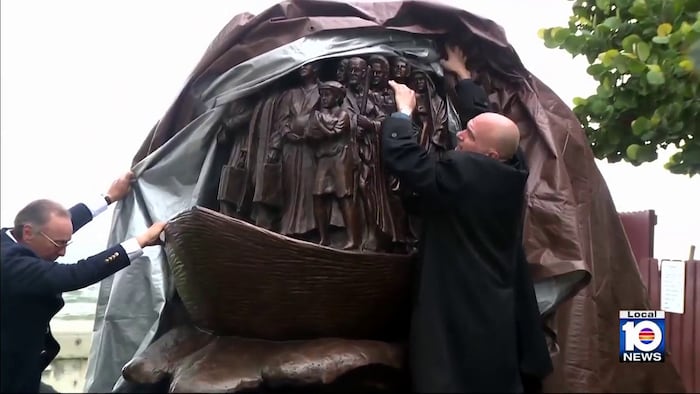
They met at the National Shrine of Our Lady of Charity to unveil two bronze replicas of “Angels Unaware,” a sculpture depicting a boat with migrants on a voyage, and “Be Welcoming,” a sculpture depicting an angel as a pilgrim resting. Hebrews 13:2 — “Do not neglect to show hospitality to strangers, for thereby some have entertained angels unawares” — was the inspiration for both.
“It shows us, or it teaches us, that we all have to treat each other with kindness,” Schmalz said.
Fernandez has used visual communication to advocate for migrants before. He funded a campaign against Republican Cuban Americans who didn’t take a strong stance against President Donald Trump’s mass deportations, including State Secretary Marco Rubio and U.S. Reps. Carlos Gimenez, Maria Elvira Salazar, and Mario Diaz-Balart.
“When we gave you funds for your campaigns, you gave us your word that you were going to be our voice in Washington,” Fernandez said about the message of the campaign. “They haven’t been.”
The Miguel B. Fernandez Family Foundation commissioned the two sculptures on display at a place rich in symbolism for generations of Catholic Cuban exiles. Wenski said these send a message about the treatment of migrants.
“We should see them not as threats, but we could say maybe strangers, but strangers that should be embraced as brothers and sisters,” Wenski said.
The sculptures outside the Marian place of worship, better known in Spanish in Miami as La Ermita de la Caridad, are steps away from a replica of the patroness of Cuba at the national shrine in El Cobre, a town in eastern Cuba. Also, just outside a chapel where many have knelt by a stained glass window facing Biscayne Bay to pray for the refugees who have perished at sea in the Florida Straits.
“Those people in that boat today are really us,” Fernandez said about the “Angels Unaware” sculpture.
Copyright 2025 by WPLG Local10.com – All rights reserved.