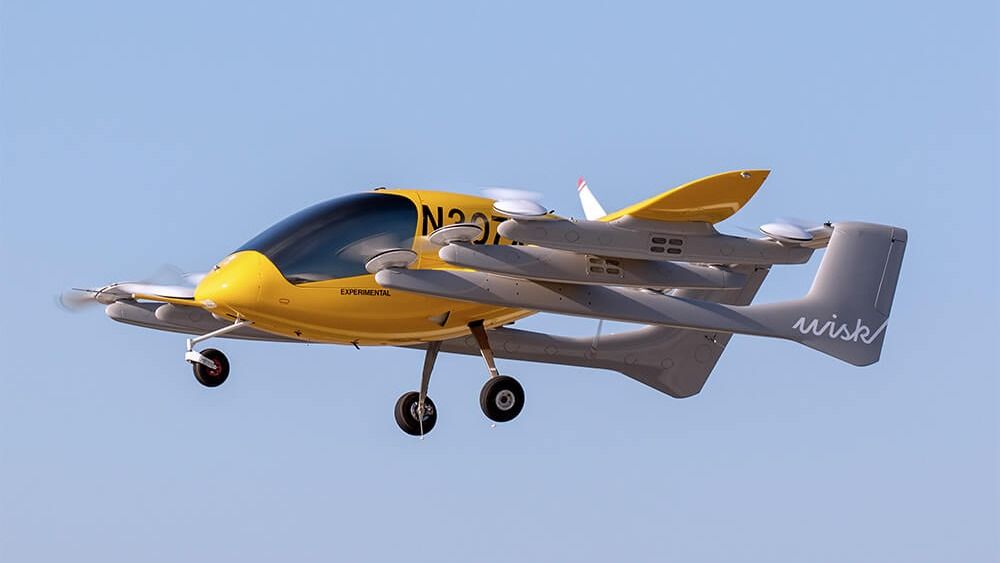
Could These Boeing-Backed Self-Flying Aircraft Take Over Miami’s Skyline?
Boeing-supported eVTOL manufacturer Wisk has chosen Miami as one of its initial launch markets for air taxi services in the United States. The company plans to identify the best locations and evaluate the potential for building vertiport infrastructure at airports throughout the Miami metropolitan area.
- Stock Code
-
BA
- Business Type
-
Planemaker
- Date Founded
-
July 15, 1916
- CEO
-
Kelly Ortberg
Miami now joins Houston, Los Angeles County, and Brisbane, Australia, as one of Wisk’s key launch markets in its global strategy to introduce air taxis to urban areas. In order to kickstart the strategic planning, Wisk signed two memorandums of understanding (MoUs) with the Miami-Dade Aviation Department (MDAD) and another with the University of Miami’s Engineering Autonomy Mobility Initiative (MEAMI). MDAD operates  Miami International Airport, which could serve as the launch site for Wisk’s autonomous air taxi in South Florida.
Infrastructure Planning At Miami Airports

Both MoUs are focused on making air taxi mobility a reality. The agreement with MDAD will concentrate on strategic planning, infrastructure development, policy frameworks, and the commercialization of autonomous advanced air mobility in Miami-Dade County and at MDAD-operated airports.
As part of the partnership, Wisk and MDAD will work together to identify the best locations and evaluate the development of vertiport infrastructure at Miami International Airport (MIA), Miami Executive Airport (KTMB), and Opa-locka Executive Airport (OPF). In addition, Wisk will provide technical guidance on the requirements for autonomous vertiport operations to help inform the design, development of infrastructure, and flight procedures. Commenting on the news, Daniella Levine Cava, Miami-Dade County Mayor, said:
“I am extremely excited about this historic first step toward making Miami-Dade County one of the first areas in the country with advanced air mobility. This collaboration with Wisk allows us to strategically plan for the future of air travel, enhance connectivity, and explore new economic opportunities for Miami-Dade County. MIA is the busiest airport in Florida and the second busiest in the country for international passengers, which makes it the perfect launch site for AAM.”
Academic Partnership For Air Mobility Progress

The second MoU with the University of Miami’s Engineering Autonomy Mobility Initiative will primarily focus on establishing a framework for “collaborative research and development that will further advance autonomous mobility technology.”
Under the MoU, Wisk will use the University of Miami’s resources and facilities while jointly pursuing grant opportunities for research and product development. Together, they will explore business opportunities aimed at advancing autonomous mobility technology, with a focus on aligning with US regulatory standards.
As of mid-2025, eVTOL aircraft are still a few years away from receiving full certification from the Federal Aviation Administration (FAA) for commercial passenger service. Because eVTOLs represent a new category of aircraft, the FAA is updating its certification processes. Full approval is expected sometime between 2026 and 2028, or even later.

Related
Wisk Aero Performs First Ever Public Demonstration Of Fully Autonomous Fixed-Wing eVTOL
Wisk Aero flew its sixth generation air taxi.
More About Wisk’s Generation 6 Aircraft

Since 2010, Wisk has developed six generations of aircraft. The first-ever public demonstration of Wisk’s completely autonomous eVTOL flight took place in July 2023, using the company’s fifth-generation aircraft.
The company’s sixth-generation air taxi, which is expected to be certified for commercial service, will be a fully autonomous electric aircraft with human oversight. It can seat up to four passengers and has a range of up to 90 miles (144 km). Wisk’s air taxi is designed to fly at speeds between 110 and 120 knots (203 to 222 km/h).
In October 2024, the FAA issued its final rule for the qualifications and training that instructors and pilots must have to operate ‘powered lift’ aircraft, including eVTOLs. At the time, Mike Whitaker, the now-former Administrator of the FAA, said that the regulator’s priority would be safety as it works to integrate innovative technologies and the associated operations seamlessly. “This final rule provides the necessary framework to allow powered lift aircraft to safely operate in our airspace,” Whitaker added.