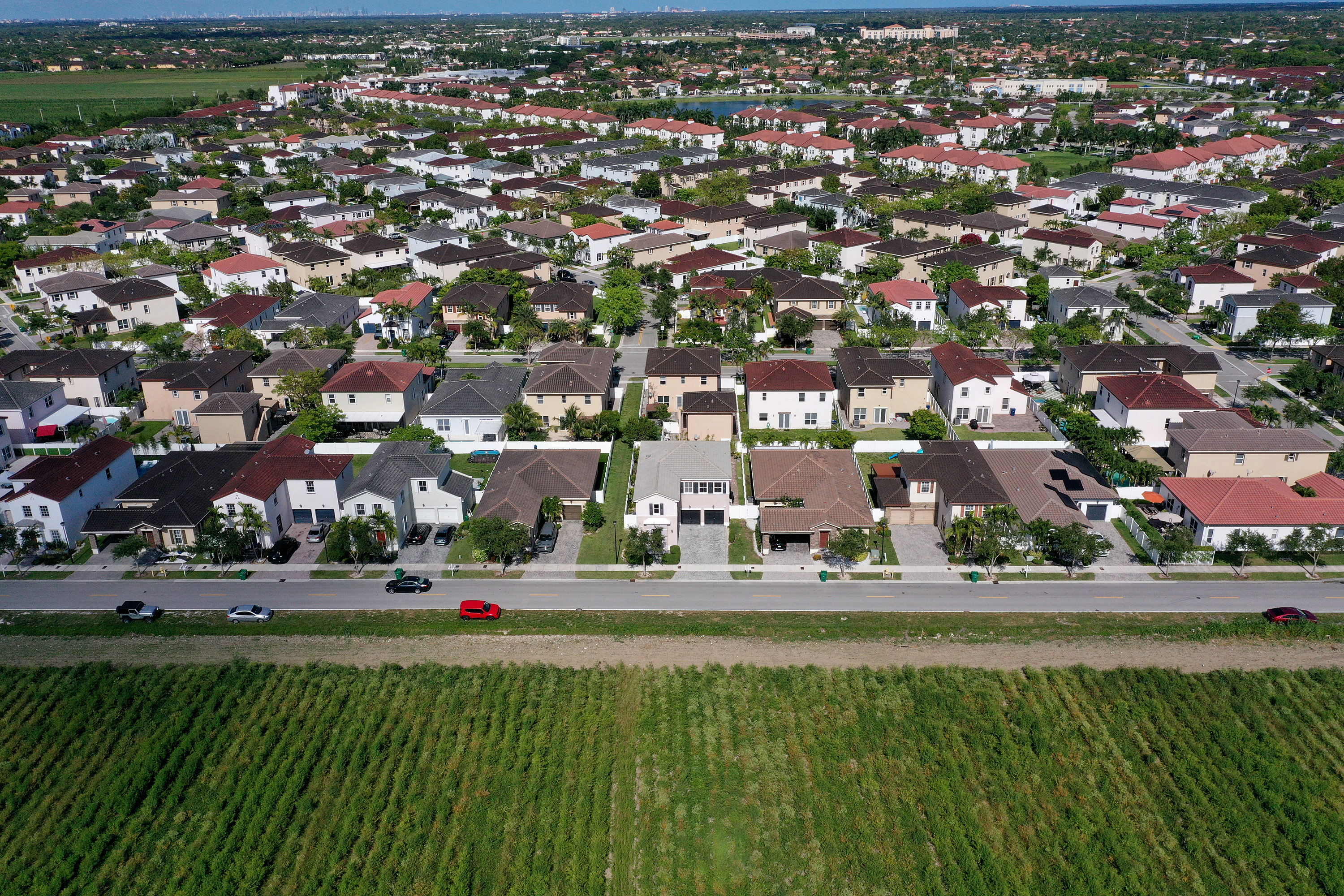
South Florida Homes for Sale Nearly Double as Residents Offload Properties
Inventory in Miami-Dade County, which includes one of the most expensive metro markets in Florida and the country, rose by over 43 percent in April compared to the same month a year earlier, according to data from Miami Realtors.
This surge in for-sale homes could be a telltale sign of an impending cooldown in Miami-Dade’s housing market, even as prices continue to rise in the county at a rate five times faster than the national level, according to Redfin data.
Why It Matters
Home prices skyrocketed in Miami-Dade and the rest of Florida during the COVID-19 pandemic, as historically low mortgage rates sparked a homebuying frenzy and the rise of remote work fueled mass domestic migration across the country to more affordable states offering a high quality of life.
In Miami-Dade, the median sale price of a home in April 2020 was $330,000, up 8.2 percent from the same month in 2019; in April 2025, it was $585,950, up 5.6 percent from the same month in 2024, according to Redfin, and nearly double what it was five years prior.
But while prices are still rising in the county, dwindling home sales and increasing inventory suggest that even the popular Miami-Dade is about to experience the same “correction” that has already hit much of Florida, where the median sale price of a home was down 3.2 percent from a year earlier in April. The county, which has long been a strong seller’s market, might soon switch in favor of buyers.
What To Know
According to the latest data shared by the Miami Realtors, the total number of active listings in Miami-Dade increased by 43.3 percent year-over-year in April, rising from 13,094 to 18,765. That represents significantly faster growth than the national level reported in the same month, with inventory nationwide up 20.8 percent year-over-year.
However, there are still not enough homes for sale to match demand: inventory is now 18.4 percent below April 2019 levels, at 22,984.
Joe Raedle/Getty Images
The inventory of single-family homes, which represents the majority of the U.S. market, increased by 43.04 percent in April compared to the same period a year earlier, rising from 3,864 to 5,527. Condo inventory rose by 43.42 percent year-over-year in the same month, for a total of 13,328 listings. Both markets have a number of homes for sale at levels below those of 2019.
The market for single-family homes, despite growing inventory, remains balanced, with a 6.3-month supply. In the condo market, buyers already have the upper hand. According to Miami Realtors, there is currently a 13.7-month supply, meaning that buyers have a wide range of options to choose from and significantly more negotiating power.
A balanced market between buyers and sellers is typically considered to offer a supply of between six and nine months.
Sales in South Florida, however, are dwindling despite rising inventory levels. A total of 2,133 homes went under contract in Miami-Dade in April, according to Redfin, down by 19.1 percent compared to a year earlier. Those homes spent an average of 81 days on the market before being sold, up 15 days from the previous year.
And yet, prices have not come down.
“The rapid price growth fueled by fierce competition during the pandemic has left home prices elevated in many areas,” Hannah Jones, senior economic research analyst at Realtor.com, previously told Newsweek.
“With mortgage rates still high, many prospective buyers are waiting on the sidelines for homeownership to become more affordable.”
Other South Florida counties are experiencing a similar surge in inventory and declining sales. In Broward County, active listings increased by 46 percent year-over-year in April, while Palm Beach County saw a 30 percent rise. In Broward County, sales were down 16.4 percent year-over-year in the same month, according to Redfin; in Palm Beach County, they were down by 10.7 percent.
Overall, South Florida’s housing inventory has nearly quadrupled since 2022, reaching approximately 52,000 active listings, due to a combination of several factors.
In part, it is because the Sunshine State has been building more new homes than any other state in the country in recent years, spurred by the sudden surge in demand during the pandemic. In part, this is because owners who were previously locked into their homes by high mortgage rates have now given up waiting for lower monthly payments and are putting their homes on the market.
Elevated mortgage rates, high home prices and rising housing costs—including homeowner association (HOA) fees and home insurance premiums—are also playing a role in the piling up of unsold inventory in the state’s market, keeping buyers on the sidelines. Some existing homeowners are deciding to leave the state to avoid rising costs and escape the growing threat of devastating natural disasters, as well as higher home insurance premiums.
What People Are Saying
Hannah Jones, senior economic research analyst at Realtor.com, previously told Newsweek: “The trajectory of home prices in Florida is dependent on the larger economic context and mortgage rates, which both impact buyer demand. Currently, many buyers are on the sidelines because still-high prices and mortgage rates have priced them out of the market.
“Affordability could improve via some combination of lower home prices and lower mortgage rates. Until buyer demand improves, it is likely that sellers in Florida will continue to reduce asking prices, hoping to spur some buyer attention.”
Miami Realtors Chairman Eddie Blanco said in a press release: “Miami and South Florida real estate continues to be a national leader in employment, population and home price appreciation gains. These Miami fundamentals are shielding the market from macroeconomic changes: tariffs, stock market fluctuations and 7 percent mortgage rates.”
What Happens Next
While the Sunshine State housing market is experiencing a cooldown that is likely to continue bringing prices down at the state level, the situation on the ground is slightly different in South Florida and Miami-Dade, where inventory remains below the pre-pandemic level.
Despite the threat of hurricanes hovering over the region, Miami-Dade also remains a relatively strong market, thanks to the pull of Miami, which is growing as a tech hub, attracting new residents, investments, and a larger workforce.
At the same time, the region’s condo market is still being affected by new building safety legislation, which came into effect at the end of 2024 and has increased HOA fees for owners, prompting many to put their properties on the market despite a lack of buyers.